Showing posts with label Revolutionary War. Show all posts

Saturday, July 4, 2026

Saturday Night Genealogy Fun - How Will You, Or Did You, Celebrate America's 250th Birthday?

 From Randy (my cousin) over at Genea-Musings:

it's Saturday Night - 
time for more Genealogy Fun!!!


Your mission, should you decide to accept it, is to:

1)  It is the 250th Anniversary of the Declaration of Independence today.

2)  How will you celebrate the day? Or, how did you celebrate the day?

Here's mine:

    Our plans for the day fell through... for various crazy reasons. In addition, it has been so hot here in Georgia, that it was just too miserable to go outside for cook outs or anything.  So today ended up being a typical quiet Saturday with chores.  

    However, I have been celebrating the 250th birthday/anniversary of our country in my own way for the past week.  As I mentioned in a previous post, I have been taking advantage of Fold3 opening up their Revolutionary War records for free through July 6th (this Monday).  I have been furiously searching, downloading, transcribing, and saving as many records of my ancestors as possible.  I am in awe of the records I am finding, and I am so proud of my ancestors, 3rd, 4th, and 5th great-grandfathers who fought for this country.

    Also Mom and I are going to see the movie, "Young Washington" on Tuesday afternoon.  We are really looking forward to that!

Monday, June 29, 2026

Military Monday

    In honor of the United States of America's 250th birthday coming up, I wanted to take this opportunity to salute the brave souls who fought for our democratic way of life in The Revolutionary War, 1775-1783. 

    For this special occasion, Fold3 is providing their Revolutionary War records for FREE through July 6th!  I immediately cleared my schedule (which was already free) and starting searching.  I have to go back and get all the information, but I did a quick perusal today in order to write this post.  

NameRelationStateUnit, Regiment, Other
Samuel Bevier
1740-1826
3rd cousin, 6x removedNew YorkUlster County (NY) Militia, 7th Regiment, Col. John Hardenburgh; Snyder’s Regiment (Ulster County Militia)
Nathaniel Bosworth
1753-1844
Spouse of 2nd cousin, 7x removedConnecticutArmorer in Captain Meigs’ Co., Colonel Spencer’s Regiment, Connecticut Troops
John Brainard
1754-1820
Spouse of 6th great auntMilitia Man; Sgt in Lt. Smith’s Company
John Prescott Bush Sr
1758-1846
Half 6th great uncleSouth CarolinaOfficer; Regiment Unknown
David Hubbard
1749-1836
1st cousin, 7x removedConnecticutPrivate, 7th Co., 5th Connecticut Regiment, commanded by Lt. Col. Isaac Sherman
Isaac H Osman
1738-1778
5th Great GrandfatherNew YorkPrivate, Orange County (NY) Militia, 1st Regiment; Died as POW
Israel Osman
1736-1778
6th Great UncleNew YorkPrivate, Orange County (NY) Militia, 1st Regiment; Died as POW (Isaac’s brother)
John Osmun6th Great UncleNew YorkSargeant, Lamb’s Artillery (Isaac and Israel Osman’s brother)
Abraham Ozmun
1764-1848
4th Great GrandfatherNew YorkPrivate, Collier (one who makes gun powder), Regiment Unknown
Solomon Page
Abt 1760-1823
3rd Great GrandfatherNorth CarolinaCorporal, Bailey’s Company
John Tapley Patterson
Abt 1746-?
1st cousin, 6x removedNorth CarolinaUnknown Unit or Regiment
Mark Patterson
Abt 1739-Abt. 1808
1st cousin, 6x removedNorth CarolinaUnknown Unit or Regiment
Comfort Ranney
1759-1859
5th Great GrandfatherConnecticutPrivate, Captain Edward Eells’ Company, Col. Samuel Wylleys’ 3rd Regiment; Discharged 29 May 1780
Elijah Ranney
1750/51-1833
2nd cousin, 7x removedVermontPrivate, Vermont Militia, Major Day’s Command of Westminster on alarm of 17 Oct 1780
Nathaniel Ranney Jr
1735-1800
6th Great GrandfatherConnecticutPrivate, Col. Samuel Wylleys’ 3rd Connecticut Regiment
Thomas Erastus Redman
1745-1836
Spouse of 1st cousin, 6x removedVirginiaPrivate, Captain James Johnson’s Company in the 6th Virginia Regiment of Continental Forces commanded by Lieut. Col. James Hendricks (Note: His war record indicates he was deceased 07 Feb 1777.)
Jeffrey Smith
1763-1846
Spouse of 6th Great AuntConnecticutContinental Army; Company and Regiment unknown.
Adam Tapley
Bet 1760-1770 - 1837
5th Great UncleNo information on his service located.


Saturday, June 27, 2026

Saturday Night Genealogy Fun -- A Revolutionary War Era Ancestor

 From Randy (my cousin) over at Genea-Musings:

it's Saturday Night - 
time for more Genealogy Fun!!!


Your mission, should you decide to accept it, is to:

1)  We all have ancestors who were alive in 1776, and some of them may have celebrated the signing of the Declaration of Independence or even served in the military during the war.

2)  Describe one or more of your ancestors who lived in that time or served in the military.

Here's mine:

    I found that I have 19 men in my family tree who served in the Revolutionary War, all on the American side.  To be honest, I have not researched these ancestors and their part in the war.  However, I found one ancestor who had a "notable, if tragic, connection to a critical moment in the American Revolutionary War."

My 5th great-grandfather, Isaac H. Osman (1738-1778), served out of Orange County, New York with the Orange County Militia, First Regiment, a/k/a Colonel Jesse Woodhull's Regiment.  

On October 6, 1777, British forces under General Sir Henry Clinton launched a major assault on the American fortifications guarding the Hudson River, specifically Forts Clinton and Montgomery.  This was The Battle of Fort Montgomery, and it was one of the most significant military engagements in the New York Highlands.

The men of the First Regiment of the Orange County Militia were essential defense of the Hudson River corridor. This region was a primary target for the British because securing the river would have effectively split the American colonies in two.  

Records indicate that Isaac Osman was taken prisoner during this battle. The loss of these forts was a severe blow to the American defense of the Hudson Valley, as it allowed the British to dismantle the defensive chain across the river. However, even though the  British achieved a tactical victory by seizing the forts, the campaign failed to achieve its strategic goal of securing the Hudson Valley.   

Following his capture, Isaac was taken to one of the infamous Sugar House prisons in New York City, which was occupied by the British at the time.  The "Sugar Houses" were sturdy, industrial warehouse buildings. These prisons were notorious for extreme overcrowding, lack of ventilation starvation, and rampant disease.  Prisoners often slept on the floors and were subjected to harsh treatment. The mortality rate there was alarmingly high due to these conditions. 

The British used both sugar houses and decommissioned ships (prison ships) because their traditional jail facilities in New York City became overwhelmed by the thousands of Americans captured in battles like the one at Fort Montgomery. Both types of facilities are remembered for the immense suffering they caused.  While the prison ships are perhaps more famous in American lore, the Sugar House prisons were equally central to the grim reality of life for prisoners of war in occupied New York.

A list of prisoners was supplied to the British Army in New York for the purpose of informing families that they needed to send food and supplies for the prisoners. The Provost Marshall of the Prison, William Cunningham, confessed later to selling the food and supplies that were sent for the prisoners.  He was later found guilty of financial crimes and was executed in London in 1791.  

Issac Osman died in the Sugar House prison of starvation in 1778.  He was 40 years old and left a wife and 8 children between the ages of 2 and 13. 

Google Gemini provided content for this blog post.  


Sunday, March 6, 2022

20,000 Strong

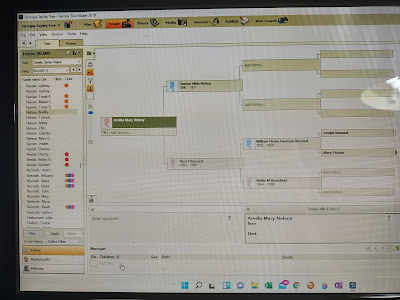
 Today, I entered the 20,000th person into my family tree on Family Tree Maker!  That is a lot of folks!  While I am not related to every single one of those people, I am kin to the vast majority. 


The 20,000th person turned out to be a 4th cousin, 2x removed on my Osmun/Osman/Ozmun line by the name of:

Arvilla Mary Nelsey (1915-2014).  

Arvilla was the wife of James "Jim" Sheldon (1914-2000), the daughter of Tinmun Mills Nelsey (1890-1971) and Vera E Buzzard (1891-1981), the mother of three, grandmother of six, and great-grandmother of ten.  Arvilla was born in Pontiac, Michigan and lived her entire life in the area. 


We are descended from Isaac H. Osman, who was a member of the Continental Army during the Revolutionary War.  He was taken prisoner at the Battle of Fort Montgomery on October 6, 1777 and sent to the infamous Sugar House Prison in New York City, where he died of starvation in 1778. 

(Of course, I kept working after entering Arvilla, and I'm already up to 20,045!)

Sources:  

Find a Grave Memorial #116935289 for Arvilla Mary Nelsey Sheldon.

Obituary of Arvilla Sheldon, 1915-2014, Sparks-Griffin Funeral Home, Lake Orion, Michigan, USA, sparksgriffin.com/obituary/4188841

Monday, November 11, 2013

Military Monday: Jacob Isaac Osman


On this Veterans Day 2013, is it fate, coincidence or just plain ironic that I learned about a patriot ancestor that I knew nothing of before?  Another veteran in my family tree for which to be thankful.

I have a "new" cousin to thank for this information.  Ted actually sent me the info two or more years ago, but I just now sat down and took a good look at it today.  I know, shame on me.  So again, I ask you, was it fate or coincidence?  I tend to not believe in coincidence.

Jacob Isaac Osman was my 5th great-grandfather.  He was born in 1732 in Southold, Suffolk County, Long Island, New York.   (I did not know I had roots in New York either!)  Isaac was a Private in the Revolutionary War.  

Forts Montgomery and Clinton were located just south of West Point, New York on the Hudson River and were built for the defense of the Hudson Highlands.   Isaac Osman and his family lived in Smith's Clove, New York, which was in the Town of New Cornwall on the other side of Long Hill west of Fort Montgomery.  

On the afternoon of October 6, 1777, approximately 3,000 Loyalists, Hessians, and British regulars attacked both forts simultaneously.  The forts were largely garrisoned by the local militia.  This militia of the district, about 600 in number, had been hastily called in the day before.  One of the regiments there that day was Col. Jesse Woodhull's regiment from Cornwall, of which both Isaac and his brother, Israel, also a private, were members.  In addition, Isaac and Israel's younger brother, John, a sergeant, was a member of Lamb's Artillery, and was also at the fort that day. 

After a few hours of intense fighting, Lieutenant Colonel Mungo Campbell and several British regulars approach Fort Montgomery waving a "white flag of truce."  The American forces, lead by Brigadier General George Clinton, sent out Lieutenant Colonel William Livingston to meet the enemy.  The British officers demand the rebels surrender and promise that "no harm will come to them."  Livingston refuses their offer of surrender and likewise invites Campbell to surender and promises him and his men "good treatment."  Outraged by Livingston's remarks, the British resume the battle.

The British closed in on all sides of the twin forts.  Lt. Colonel Campbell is killed in a violent attack on the north side of Fort Montgomery.  It is here that the British and Loyalist Troops overwhelm Clinton and the Orange County Militia, who are defending Fort Montgomery.  After a fierce resistance lasting until nightfall, the British overrun the Americans and gain control of Fort Montgomery and Fort Clinton, and lead the courageous Militiamen from the fort at the point of their bayonets.  The American Patriots who were not killed in battle or did not escape were shipped off to the Sugar House Prison in New York City.  Among those were Isaac and Israel Osman. 

Now I am not very schooled in the Revolutionary War.  I had never heard of these Sugar House Prisons.  So of course I checked Wikipedia and found that during the 18th century, a large part of commerce in New York City was trade with the British West Indies.  Destined for refineries, sugar and molasses were imported and stored in warehouses built by merchant families.  Three of these large structures - Livingston's, Rhinelander's, and Van Cortlandt's sugar houses in Manhattan - were known for being used by the British Army to house prisoners of war during their occupation of New York City.  They also housed prisoners in British ships anchored in New York Harbor.

The Livingston sugar house (on the left) on Liberty Street in Manhattan, circa 1830.


 The treatment of these prisoners were horrific.  The fledgling American government or the prisoners' families were expected to furnish food and supplies.  However, it was discovered that the Provost Marshal of the Prison, William Cunningham, had been selling the food and supplies that were sent for the prisoners.  In addition, conditions were not sanitary due to overcrowding, etc.  During the occupation of New York City by the British, it is estimated that 17,500 prisoners perished on the ships and in the prisons from starvation, smallpox, dysentery, typhus, and yellow fever, more than double that of casualties from battle. 

Both Isaac and his brother, Israel, died in the Sugar House Prison.  They were buried in unmarked graves somewhere in New York City, possibly in the Trinity Churchyard. 

In Lower Manhatten at the corner of Broadway and Wall Streets in the Trinity Churchyard, there is a memorial where Patriots of the American Revolution are remembered.  This monument was erected by church leaders in 1852.  It honors not only my ancestors, Isaac and Israel Osman, but all of the unknown American soldiers and sailors of the Revolutionary War who were imprisoned, died, and buried in unmarked graves.  

            Monument to Revolutionary War prisoners at Trinity Church, Manhattan. Photograph by Joshua Ruff.
 And what became of their younger brother, John, you may ask?  When I started writing this post, I did not know.  During the course of my research, I found his name on a list of 8,000 men who were prisoners on board "The Old Jersey," or the "Hell," as she was called, a prison ship anchored in the East River.  Often more than a thousand prisoners at a time were confined in her, and they endured terrible suffering.  Her nickname came from its inhumane conditions and the obscenely high death rate of its prisoners.  


John was one of the fortunate few who survived that experience.  I do not know how, but he did.  He lived to be 71.  

So three brothers went to war and fought for the new country they believed in.  Only one came back.  I am sure he was not the same man who left.  

To say that I am proud of the sacrifices my ancestors made for this country would be an understatement.  I am humbled by their courage and perseverance.