Thursday, April 14, 2022

Skiing, Senator Bob Dole, The Von Trapp Brothers, the 10th Mountain Division... and my Cousin

 Private First Class (PFC) Lyle M. Ozmun (1917-1944) (my 4th cousin, 1x removed) was inducted into the U.S. Army on February 23, 1944.  He received training at Camp Roberts, California and Camp Swift, Texas before going overseas in December 1944.  

Lyle grew up in Winona, Winona County, Minnesota.  Now when I think of Minnesota, I think of cold almost year around with lots and lots of snow.  However, it turns out that Winona is located on the banks of the Mississippi River in what is called the bluff country. Theirs is the warmest climate of any in Minnesota.  Temperatures are generally very mild by Minnesota standards year around; the January average is 17.6 degrees (-8 C) while that of July is 75.8 degrees (24.33 C).  Winona  has a humid continental climate with hot, humid summers and cold, snowy winters.  

Location of Winona County, Minnesota


With an average snowfall of only 37.6 inches, it does not sound like it's the skiing capital of the world.  So I wonder if Lyle knew how to ski before he joined the Army.  I think he may have.  Why is that important, you may be asking.  Hold on and keep reading.

Meanwhile, even before the United States entered the war in Europe, the government created the Mountain Winter Warfare Board to design and test winter equipment and transportation. The National Ski Patrol had a unique relationship with the military by which they recruited experts in skiing and mountaineering for the U.S. Army.  In November 1941, the War Department established the 1st Battalion of 87th Mountain Infantry Regiment as a mountain battalion.  Their first home was Fort Lewis, Washington with training at nearby Mount Rainier.  

The Army then created the Mountain Training Center (MTC) at Camp Carson, Colorado, but a national search for a suitable location for winter/mountain training led to the development of a site in the Colorado Rocky Mountains close to Leadville that became Camp Hale.  This became the home post of the MTC in November 1942.  The 10th Mountain Division became the alpine combat arm of the U.S. military.  Eighteen units comprised the 10th Mountain Division, but this post is going to concentrate on the 85th, 86th, and 87th Mountain Infantry Regiments.  

The 10th Mountain Division trained at Camp Hale, Colorado, where volunteers learned rock climbing, endurance through long distance marches and cross country ski trips, down hill skiing, winter/mountain survival techniques, and combat throughout the winter of 1943-1944. In June 1944, the Division transferred to Camp Swift, Texas, for additional training until the division was deployed to Italy in December 1944 - January 1945.   

Remember that Lyle Ozmun received training at Camp Swift?  Well, this is where the two stories come together.  Somehow Lyle ended up in the 10th Mountain Division while at Camp Swift.  He became an infantry machine gunner with M Company of the 85th Infantry Regiment.  (This is why I believe Lyle knew how to ski, specifically cross-country ski, because he became a part of the 10th Mountain Division without going to Camp Hale and training for winter/mountain combat.)  He shipped out with the 10th, and the Division became active in the mountains of Italy on January 5, 1945.  

The saga of the 10th Mountain Division is unique in the history of the U.S. Army, and its arrival in the Italian Theater was a noteworthy event.  A brand new division of infantry was a rare sight among the battle-weary soldiers already there, and these fresh troops were already considered elite before they fired their first shots.  This was not because they had battlefield exploits under their belts.  The 10th was specifically outfitted and trained for winter warfare.  These were soldiers whose basic equipment included skis, and each man had been required to present written recommendations for inclusion in the unit.  (I wonder who wrote Lyle's recommendation?)  The ranks of the 10th Mountain included many of the finest skiers and winter sports enthusiasts in the U.S.  Ski instructors and competitors from across the country volunteered.  Malcolm Douglass, who had driven a dog team during Admiral Richard Byrd's expedition to the South Pole in 1940, came forward, as did Norwegian-born Torger Tokle, holder of the world ski jumping record.  Werner and Ruppert von Trapp (yes, from the famous family featured in the musical, "The Sound of Music") both served in the 10th Mountain Division after fleeing from Austria and eventually joining the U.S. Army.

Uniform of the 10th Mountain Division
courtesy of the National Association of the 10th Mountain Division

The majority of the 10th personnel were college educated and members of families that were at least affluent, often wealthy, and sometimes politically connected.  So of course, the veterans of other units resented the ski boys.  The 10th had stood on the sidelines of the war for months as other commanders declined to employ them.  In the snow and ice of Northern Italy, however, troops trained in mountain warfare might be used to an advantage.  Still many wondered whether these soldiers could fight.  They did not have to wait long for an answer.  

U.S. and Brazilian soldiers had been unsuccessful in breaking German lines established in the northern Italian Alps.  From Naples, the 10th Mountain set sights on routing the Germans from Mount Belvedere, which provided the key to advancement into the Po Valley.  Securing Mount Belvedere depended on routing German artillery entrenched on Riva Ridge, a three-and-a-half mile ridge connecting a series of mountains.  Warm weather made the specially designed winter camouflage clothing and equipment useless and the planned assault on Riva Ridge required climbing rather than skiing.  On the night of February 18, 1945, companies of the 86th Regiment scaled Riva Ridge surprising the Germans. 

A captured German officer commented, "We didn't realize that you had really big mountains in the United States, and we didn't believe your troops could climb anything that awkward."  

The capture of Riva Ridge enabled the 85th and 87th Regiments to move on to Mount Belvedere and the adjacent peaks Mounts Gorgolesco and della Torraccia.  By April 20th, the 10th Mountain Division entered the Po Valley, and after heavy fighting, the German Army in Italy surrendered on May 2, 1945.  In the campaign in Italy, the 10th took heavy losses with 4,888 casualties including 978 killed in action.  In capturing the peaks alone, the 10th  suffered over 900 casualties.  These included Lyle and... Bob Dole!   

 Bob Dole in his officer's uniform circa 1944.  

It turns out that Lt. Robert "Bob" Dole was a rifle platoon leader in Company I of the 85th Infantry Regiment!  Dole wrote later "I thought it was mighty odd that a kid from Kansas who had seen a mountain up close only once in his life would be assigned to lead a platoon of mountain troops.  We Kansans didn't ski much."

During what was called the Spring Offensive (April 14-16, 1945), the 85th Regiment was selected as one of two regiments to spearhead the attack.  The mission of the 85th was to attack due north and seize Hills 913, 909, and 860 (near the small town of Castel d'Aiano). 


On the morning of April 14, the assault began. First, bombers pummeled the German bunkers. Then, Dole and his men were instructed to move across the valley and take control of Hill 913.  

It was slow going. They mostly crawled through the valley, between hedgerows and stone walls, watching for land mines and under heavy machine gun fire. His men were being picked off one by one. By the end of the day, 98 U.S. soldiers would die on Hill 913.  

Dole searched for his radio operator to call for reinforcements. The man was slumped over in his own blood, radio in hand.  Dole crawled over to him to pull him to a shell hole.

And that's when it happened.

Dole said he felt a sting as something hot and powerful crashed into his upper back behind his right shoulder.  It could have been a mortar round, an exploding shell, or machine gun fire.  Whatever it was, it tore through his shoulder and spine instantly paralyzing him from the neck down.  

Due to the heavy fighting, it was more than six hours later before he was evacuated.  Lt. Dole spent 40 months recovering in hospitals.    

On April 15, the battle continued.  Lyle's Company M was using their heavy weapons to support the attack from Hill 913.  Again, progress was slow, as the Germans fought fanatically to hold their ground, but the Allies were ultimately successful.  And even though the capture of Hills 913 and 909 was possible only by a heavy sacrifice of blood and American lives, it was this effort that paved the way for the advance to the Po Valley.  After the 85th had seized the hills, the 86th and 87th were able to push rapidly to the northeast across Mt. Pigna, Rocca di Roffeno and beyond.  

So by the third day, April 16, strategy became the withdrawal to defensive positions.  Because of the 87th Mountain Infantry's rapid advance, it was decided to abandon any further attack through the mountains, and follow the 87th to defend their flank.  When the 85th followed to the northeast, Castel d'Aiano and Hills 913 and 909 would be taken over by the British Expeditionary Forces.  The plan was executed in a series of moves.  However, the troops were heavily shelled by the enemy along the way.  Somewhere and some time in the midst of all the movement on April 16th, Lyle was killed in action on Hill 913.  I am sure his family and his hometown were devastated. He received a Bronze Star and Purple Heart for his sacrifice.  


 Lyle was buried in the Florence American Cemetery and Memorial in Italy.  The cemetery covers 70 acres, set in wooded hills.  There are 4,392 of our military dead laid to rest there.  The headstones are arrayed in symmetrical curved rows upon the hillside.  They represent 39% of the U.S. Fifth Army burials originally made between Rome and the Alps.  Most died in the fighting that occurred after the capture of Rome in June 1944, however, included among them are casualties of the heavy fighting in the Apennines Mountains of northern Italy.  

Final note... The 10th Mountain Division helped popularize skiing in the U.S.  After the war, returning ski soldier veterans from the 10th were largely responsible for introducing skiing as a recreational sport, especially in Colorado.  


Sources:

Brockell, Gillian.  "Bob Dole wanted to be a doctor. One of WWII's last battles changed everything for him." The Washington Post, December 5, 2021, available at https://www.washingtonpost.com/history/2021/12/05/bob-dole-world-war-ii-hero/.  Accessed April 12, 2022.

Case, Mike, "Skiing, Sen. Bob Dole and the Von Trapp Brothers:  10 Facts About the 10th Mountain Division," USO website, originally posted in 2019, updated July 9, 2021.  Available at https://www.uso.org/stories/2396-skiing-sen-bob-dole-and-the-von-trapp-brothers-10-facts-about-the-10th-mountain-division#.  Accessed April 12, 2022.

Decedent Search.  Lyle M. Ozmun.  American Battle Monuments Commission. Available at https://www.abmc.gov/decedent-search/ozmun%3Dlyle.  Accessed April 11, 2022.  

Find a Grave, database and images (https://www.findagrave.com/memorial/56365831/lyle-m-ozmun : accessed 11 April 2022), memorial page for PFC Lyle M Ozmun (9 Nov 1917–16 Apr 1945), Find a Grave Memorial ID 56365831, citing Florence American Cemetery and Memorial, Florence, Città Metropolitana di Firenze, Toscana, Italy ; Maintained by Coleman ✿ (contributor 47076912).

Florence American Cemetery.  American Battle Monuments Commission. Available at https://www.abmc.gov/Florence.  Accessed April 12, 2022.  

Haskew, Michael E., "Surging toward the Alps: Last Battles of the Italian Campaign," Warfare History Network website.  Available at:  https://warfarehistorynetwork.com/2016/09/12/surging-toward-the-alps-last-battles-of-the-italian-campaign/.  Accessed April 12, 2022.

Metropolitan State University (MSU) of Denver, Denver Colorado, website page "Camp Hale." Available at https://temp.msudenver.edu/camphale/10thmountaindivision/.  Accessed April 11, 2022.

Wikipedia contributors. Winona, Minnesota. Wikipedia, The Free Encyclopedia. April 11, 2022, 11:04 UTC. Available at: https://en.wikipedia.org/w/index.php?title=Winona,_Minnesota&oldid=1082107372. Accessed April 11, 2022.

Woodruff, John B., Captain, 85th Mountain Infantry, Historical Records Officer, 1945, "History of the 85th Mountain Infantry Regiment, 4 January 1945 - 31 May 1945."  Accessed April 11, 2022.

Saturday, April 9, 2022

Saturday Night Genealogy Fun - Four Things!

  From Randy (cousin discovery!!) over at Genea-Musings:

it's Saturday Night 
time for more Genealogy Fun!!!


Your mission, should you decide to accept it, is to:

(1)  Let's answer some family history related questions with four responses (Four Things!).

(2)  Tell us all about it in your own blog post, in a comment to this post, in a post on Facebook, or on Twitter.  

Here's mine:

Four names I go by:

(1)  Liz
(2)  Elizabeth
(3)  Lizard
(4)  Mama 

Four places I have lived:

(1) Swainsboro, Georgia
(2) Milledgeville, Georgia
(3) Covington, Georgia
(4) Durham, North Carolina

Four ancestral places I have visited:

(1)  Johnson County, Georgia
(2)  Jacksonville, Florida
(3)  Pendleton, South Carolina
(4)  Redlands, California

Four interesting places I have visited:

(1)  Williamsburg, Virginia
(2)  Los Angeles, California
(3)  Amsterdam, Netherlands
(4)  Washington, D.C.

Four favorite/most interesting ancestors/family members:

(1)  Morgan Goodgame Swain (1805-1851)
(2)  Stephen Hopkins (abt. 1581-1644)
(3)  Gordon Wesley Tapley (1894-1959)
(4)  Sarah  Tapley (1775-bet.1850-1860)

Four favorite genealogy record collections:

(1)  Obituaries
(2)  Historical newspapers
(3)  Marriage records
(4)  Military records, including pension applications

Friday, April 1, 2022

No April Fool's Joke Here - The 1950 U.S. Census was Released Today!

 It's like a birthday and Christmas all rolled into one day for genealogists in the United States (or anyone in the world who had family in the U.S. at that time)!  Census release day only comes along every 10 years so it is a BIG DEAL.

There is a 72 year restriction on access to census records.  So the latest available is now 1950.  It can be accessed for free through a dedicated website at 1950census.archives.gov. This census was the 17th census of the United States.  Taken every 10 years since 1790, the U.S. Census provides a snapshot of the nation's population. The questions on the census evolve each time to reflect the current social norms or changes in the world.  For example on several of the first censuses taken, only the "head" of the household was listed, this most often being a man.  Women and children were just numbers under age categories.  I read that the 1950 census asked whether the household had a TV (though I have yet to find that question myself!!).  

Now most of my genealogy friends and acquaintances stayed up until midnight and later this morning to see the 1950 census first thing.  I did not, for a couple of reasons.  First of all, I needed to go to bed to be able to go to work this morning.  And secondly, it is hard to search the census when it first comes out.  It does not come out of the chute already indexed so you can search by name.  Now this census is the first one that was digitized, and it is the first time that artificial intelligence/optical character recognition (AI/OCR) technology will be used.  However, that is not perfect.  Handwriting can be difficult to decipher, for both humans and machines.  So you must locate the proper Enumeration District where your family member(s) lived in 1950.    I was feeling a little left out and jealous of my friends, so I decided to do a little peek tonight.  I really didn't think I would find much.  I chose to do my searching on Ancestry.com, and it was not easy, let me tell you.  The map was difficult to navigate, but I got lucky.

I decided to start with Jacksonville, Florida.  I was pretty positive that my father was living there then.  I know with certainly that my Uncle Russ Tapley was living in Jacksonville, and I remembered he lived on 3rd Avenue.  Fortunately, I know my way around that part of Jacksonville pretty well, so I was able to pull up the map on Ancestry and find the area of town (Riverview) where 3rd Avenue was located.  That map is tricky, but I figured out my uncle probably lived in Enumeration District 16-11. 

Then I went to the actual images of the count.  There were 37 pages for that Enumeration District.  I scrolled through the first few pages, looked at the street names, and I knew I was close.  On page 17, I found 3rd Avenue!  I went to page 18, and there was my father with his first wife and their two children, my brother and sister!  I had no idea they lived on the same street as Uncle Russ!


My father, Gilbert E Tapley, age 22, married, from Georgia and a carpenter, along with his wife, Margaret E. Tapley, age 22, from North Carolina who was a homemaker, and their children, Harry E. Tapley, age 3, and Patricia E. Tapley, newly born September 1949, both born in Florida.  They lived at 2351 3rd Avenue.  

As you can see, my sister, Patricia (Pat) ended up on line #16, a sample line.  Unfortunately, that didn't add any new and interesting information since she was only 6 months old!

This looks to be the family at about the right time frame.


Full page image


Well, where was Uncle Russ then?  I went back to page 17 and there he was!  Along with his wife and his mother (my grandmother, Nealie Drake Tapley)!

My uncle, John R. Tapley, age 32, married, from Georgia, and a carpenter.  His wife, Elizabeth E. Tapley, age 27, from Florida and a homemaker, and his mother, Nealie V. Tapley, age 55, from Georgia. They lived at 2344 3rd Avenue.


I don't know if this was 1950, but Uncle Russ and Aunt Elizabeth had a TV!


I may try to find my mother on the census another day.  She was living in California, and I am not familiar with the area.  I will have to find the address where she was living, and really study some maps to find it and thus the Enumeration District!  Otherwise, I will just wait for the indexing to be complete.  It will still be new and exciting for me then.  

At least I got in on the fun today!

Saturday, March 26, 2022

Saturday Night Genealogy Fun - Your Fearless Females' Education

 From Randy (cousin discovery!!) over at Genea-Musings:

it's Saturday Night 
time for more Genealogy Fun!!!


Your mission, should you decide to accept it, is to:

(1)  It's National Women's History Month, so I'm going to use today's prompt from Lisa Alzo on her The Accidental Genealogist Blog.  What education did your mother receive? Your grandmothers? Great-grandmother's?  Note any advanced degrees or special achievements.

(2)  Tell us all about it in your own blog post, in a comment to this post, in a post on Facebook, or on Twitter.  

Here's mine:

(1)  My mother, Linda Tapley (1942-) went to various schools in "The Valley" in California as a young child.  Her father moved the family often, following work.  She graduated from Redlands High School, Redlands, California in 1960.  She graduated from San Bernardino Valley College in San Bernardino, California in 1962.  Then the family moved back east to Tallahassee, Florida, and she attended Florida State University for a short while. 

Linda Irene Tapley, 1962
Graduation from San Bernardino Valley College

 
(2) My maternal grandmother, Ethel Irene Ranney Tapley (1913-1973), grew up in Duplain, Michigan so I assume she attended elementary school there.  She was probably about 9 or 10 when the family moved to California so she would have continued her elementary schooling there.  She graduated from Redlands High School in 1932. In her 1933 diary, she writes of attending school, but she never mentions what kind of school. My mother let me know that Grandma went to business school.

Ethel Irene Ranney, 1932
Redlands High School Senior Portrait


(3) My paternal grandmother, Nealie Drake Tapley (1895-1970), grew up in the Adrian area of Emanuel County, Georgia.  I assume she attended school there, but I have no information about her education.  What I do know is that my grandmother was a dedicated organist who drove her horse and buggy probably 10 miles or more each way to play the organ at Powell's Chapel Church every Sunday.  

(4)  My great-grandmother, Bessie Alice Carter Ranney (1883-1960), grew up and attended school in Eagle Grove, Iowa.  She graduated from Eagle Grove High School in 1901.  She married five years later, and I do not know if she attended any college in between.  My mother  shared that Bessie attended "normal school" after high school. This was higher education for girls at that time to provide them enough education to teach school before they married.  

Bessie Alice Carter, 1901
Eagle Grove (Iowa) Graduation Photo


I do not know anything about the education or talents of my other great-grandmothers:  Emma Vermell Harrell Drake (1867-1935) of Emanuel County, Georgia; Elizabeth Rebecca "Becky" Page Tapley (1844-1924) of Johnson County, Georgia; or Mattie Schwalls Tapley (1877-1912) of Johnson County, Georgia.  I can only guess that some may have attended elementary school or high school, but none of them attended college.  

(I am sure I will be updating this post after my mother reads it and provides corrections and/or additions.  ;)
(Told ya! ;)

Saturday, March 19, 2022

Saturday Night Genealogy Fun - What is Your Favorite Record Type?

 From Randy (cousin discovery!!) over at Genea-Musings:

it's Saturday Night 
time for more Genealogy Fun!!!


Your mission, should you decide to accept it, is to:

(1)  What is your favorite record type or resource? Not a website, but a type of record - e.g., census, cemetery, land, etc.  Why?

(2)  Tell us all about it in your own blog post, in a comment to this post, in a post on Facebook, or on Twitter.  

Here's mine:

My favorite record type is obituaries.  While I realize obituaries are not primary sources, they are still valuable to me as part of my genealogy "toolbox."  I have found the names of parents, siblings, children, and sometimes grandparents.  I have found the deceased's date and/or place of birth or the date they got married, along with the name of their spouse(s).  I have found occupations and what their hobbies were.  Every once in awhile, I can find a cause of death.   It's a goldmine of information, especially for someone from a branch of  my family that I am not as familiar with.  

I know that the information provided in an obituary comes from a family member or friend of the deceased.  I am sure that many times, the obituary is a group effort made up of several family members and perhaps even funeral home staff.  So there is bound to be some mistakes along the way.  Just today, I found a mistake in my sister's obituary.  I was listed as Sue Tapley of North Carolina.  So I know it happens.  However, I have found that there are mistakes in all types of records.  If it is information I did not have before, the facts I find in an obituary, even if not entirely correct, puts me on the path to finding the correct information!  

My favorite type of obituary is a long obituary, full of information about the person's career, organizations they belonged to, and hobbies and interests they pursued.  The perfect obituary includes the person's maiden name, their mother's maiden name, the full names of their children's spouses, and to which child each grandchild belongs to.  

I find a lot of obituaries on Find-a-Grave that have been transcribed or copied by members and added to a person's memorial page.  If the person passed in the last few years, I do a Google search with "the person's name, year (if known), location, and [the word] obituary" in the search box.  I can find some older obituaries by doing a search on Newspapers.com (for which I have a paid membership).  I have also found obituaries on Ancestry.com where someone has uploaded them to a person's page.  I have subscribed to obituary announcements from funeral homes in my hometown.  Many years ago, I found an entire display of index cards with obituaries on them in my hometown's library.  What a find!  

Obituaries have been invaluable to me in piecing together relationships, for example, for my Schwalls line.  Finding the names of parents or siblings in an obituary was so helpful in putting together that part of my family tree, since the members of that family are so dang elusive!

Sunday, March 6, 2022

20,000 Strong

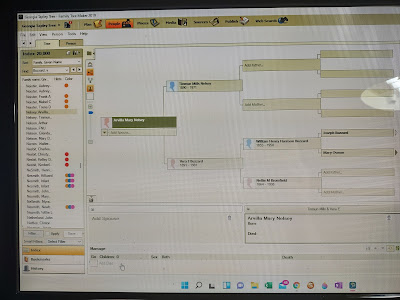
 Today, I entered the 20,000th person into my family tree on Family Tree Maker!  That is a lot of folks!  While I am not related to every single one of those people, I am kin to the vast majority. 


The 20,000th person turned out to be a 4th cousin, 2x removed on my Osmun/Osman/Ozmun line by the name of:

Arvilla Mary Nelsey (1915-2014).  

Arvilla was the wife of James "Jim" Sheldon (1914-2000), the daughter of Tinmun Mills Nelsey (1890-1971) and Vera E Buzzard (1891-1981), the mother of three, grandmother of six, and great-grandmother of ten.  Arvilla was born in Pontiac, Michigan and lived her entire life in the area. 


We are descended from Isaac H. Osman, who was a member of the Continental Army during the Revolutionary War.  He was taken prisoner at the Battle of Fort Montgomery on October 6, 1777 and sent to the infamous Sugar House Prison in New York City, where he died of starvation in 1778. 

(Of course, I kept working after entering Arvilla, and I'm already up to 20,045!)

Sources:  

Find a Grave Memorial #116935289 for Arvilla Mary Nelsey Sheldon.

Obituary of Arvilla Sheldon, 1915-2014, Sparks-Griffin Funeral Home, Lake Orion, Michigan, USA, sparksgriffin.com/obituary/4188841

Saturday, March 5, 2022

Saturday Night Genealogy Fun - RootsTech 2022

 From Randy (cousin discovery!!) over at Genea-Musings:

it's Saturday Night 
time for more Genealogy Fun!!!


Your mission, should you decide to accept it, is to:

(1)  The RootsTech 2022 Virtual Conference was Thursday through Saturday (March 3rd-5th) this week.  Did you register and attend classes?  Did you watch the Keynote talks? Did you visit the virtual Expo Hall?  What was your favorite experience?

(2)  Tell us all about it in your own blog post, in a comment to this post, in a post on Facebook, or on Twitter.  

Here's mine:

I registered for RootsTech 2022 months ago since I attended last year and thoroughly enjoyed it.  I took two days of vacation time for this.  I participated all three days, only taking bathroom and meal breaks.  I guess that's why I didn't write a blog post about the experience.  

I checked out RootsTech Relatives prior to the conference starting.  I have 44,981 relatives there; I only looked at maybe 10-12 of those!  The closest cousin match I had is a 2nd cousin, 2x removed.  That's pretty good!  Turns out, after checking with a cousin on Facebook, who turned out to be this person's aunt, that I am acquainted with her mother, uncle, and aunts already.  I had one 3rd cousin connection that I already know!  We met in person for the first time in December!  Then I had several 3rd cousins, 1x and 2x removed.  I researched a few of them, and sent messages, hoping to make connections.  I haven't heard back from anyone  yet, but I'm keeping my fingers crossed.  

Looking at the relationships between these cousin matches and myself, I have found some information I did not have and am busily working on extending my family tree!  I rarely use FamilySearch so I've been missing out.

The only Main Stage items I watched were "Ancestry For All" and "The 1950 U.S Census and You."  The Ancestry.com video made me very excited for the things they are working on, and the great things ahead for users.  I am especially interested in the partnership between Ancestry and Photomyne that will allow users to upload pictures, negatives, historical documents, etc. to the galleries of our ancestors for FREE.  Hearing about the 1950 census (and the handwriting recognition technology!) and seeing Crista Cowan's enthusiasm for the release has me getting more excited every day!  This will be the first census that my mother will be included in the enumeration.  I'm looking forward to getting a peek at where she and her parents were in 1950.  

I added many videos and classes to my Playlist.  I did watch a lot of them.  Luckily, I have more time to watch all of them!  Some of the ones I watched were:

    - "Tarheels:  Genealogy in Colonial Virginia and the North Carolinian backcountry" by Jonah Ryan            Barnes  
    - "Maximizing Messages" by Michelle Patient (messages to cousin matches!)
    - "What to Do with Your DNA Test Results in 2022, Part 1" by Diahan Southard  (Looking forward to             watching Parts 2 and 3 also.)
    - "No Time? Try Five Minute Family History  Ideas" by Taralyn Parker
    - "A Call to Arms Part 1. Researching Revolutionary War Ancestors" by Melanie McComb 

I also visited the Expo Hall, though I did not explore it as much as I probably should have.  I chatted with a Family Tree Maker customer service rep about the companion manual for FTM2019.  I also watched the videos they had about the software, and I learned some very cool things this software will do that I was not even aware of!  It's the little things that are so exciting.  I visited Ancestry in the Expo Hall and watched some of their videos.  I also plan to visit Photomyne's "booth" and watch the videos they have posted there.  

This opportunity to attend RootsTech from my own home for FREE has been the best gift of the pandemic for me.  Otherwise, I would not be able to attend.  I thoroughly enjoy most of the classes, and I learned so much that my head was spinning at the end.  So I cannot say that I had one favorite experience, but I can say that I discovered two new teachers/presenters that I loved and hope to see again.  

    - First is Taralyn Parker.  I watched three of her presentations.  The above mentioned Five Minute Family History Ideas, but also "Power of the Post: Making Connections through Social Media," and, my favorite, "Finding Your Cousins on Instagram."  Taralyn is full of enthusiasm and it shows.  She explains things well. and she is full of great ideas.  Her energy was awesome.  I had joined Instagram years ago, but rarely used it.  She got me excited to sit down and learn out to use it, the purpose of hashtags, and how to participate on the app fully.  

    - Next is Jonah Ryan Barnes.  I watched two of his presentations at this year's RootsTech: The one mentioned above about researching in Colonial Virginia and North Carolina and the other was "Cracking the Internet: Stop Bumbling and Start Searching like a Pro."  (His wife, Charlotte, helped him on the last one.)  Jonah is FULL of energy.  He talks fast but he's understandable.  That is a huge help in squeezing in all the information he needs to share in 20 minutes.  He's funny.  His hints and tips for searching the Internet like a pro were great!  

Luckily, most of the classes shared a handout, syllabus, or copies of their Power Point slides with the attendees.  I saved all of those so I can refer to them as needed.

I am most looking forward to working with my DNA results more and figuring out how I'm related to my matches.  This will lead me to use DNA Painter, which I heard great things about at this conference.  I want to try out the new Ancestry feature for enhancing photographs.  I want to continue to use Instagram and Facebook to try to find new cousins.  I want to research my Revolutionary War ancestors.  I want to finish watching all the classes I didn't get to the last three days...

My goodness, I already thought I don't have enough time to try and do all the genealogy things I want, but I REALLY do not have enough time now!  There are not enough hours in the day... plus real life interferes... What are the chances of my becoming independently wealthy?  Then I could stay home and do genealogy all the time... A girl can wish, can't she?